Saturday, January 7, 2023

Creamed Corn


There are many recipes for creamed corn. The Brookville Hotel, Brookville then Abilene, KS, was famous for its recipe made with real heavy cream. There is creamed corn made with cream cheese and other cheeses, cooked on the stove top or made in the crock pot. Having southern roots myself, there is rarely a recipe in the South that a pig did not have to die for, so anything that starts with frying bacon is automatically enhanced. 

In a large skillet, fry four or five slices of bacon until crispy. Remove the bacon and crumble it. Leave drippings in the pan and add five cups of corn (fresh or frozen). Sprinkle in a couple of tablespoons of flour for thickening, add a cup of heavy cream and two or three tablespoons of sour cream (if you like sour cream). Cook, stirring constantly, until tender, seasoning with salt and pepper. Top with crumbled bacon. You can make this with butter instead of bacon, but the bacon flavor transforms the dish. For simpler flavor, just use the butter.

Rarely, is creamed corn left from one meal to another.

Photo--Paula Deen's Creamed Corn

Corn and Annuities


Mark Brooks, site director at the Kaw Mission and Last Chance Store Museums in Council Grove, KS, shares historic tidbits regularly on social media. Since we're on the topic of corn, I found this one particularly interesting:

By Indian department contracts of April 22, 1843, J.M. Hunter was to deliver eight yoke of Oxen and yokes ( for $324.48 ), and J.C. Berryman was to supply 30 bushels of potatoes and 30 bushel of seed corn ( for $68.75 ), at the "Kanzas Village," before May 1. Agent R.W. Cummins subsequently reported, in September, that the Kansa had been "almost in a state of starvation" in the spring and had "subsisted a part of the year on roots"; that "at their pressing request" he had "employed about 18 hands and cultivated about 200 acres of corn & planted 30 bushels of Irish potatoes for them" after they agreed to "turn in and plant & tend as much corn as they could"; and to his surprise "they raised themselves more than they had done for many years" and would probably " have corn plenty to do them" over the winter. Cummins also mentioned that their horse mill was in contract, and would be soon completed.


Friday, January 6, 2023

Food Has A Past, Too


Walking through the  aisles in the Topeka grocery store, I surveyed the shelves for cornmeal. Lord knows I had seen cornfields aplenty, far larger than the ones back home in the Blue Ridge Mountains. Surely, there was some decent cornmeal to be had. But alas, my efforts were futile.

Weeks later, I was in the local doughnut shop when I spied a group of farmers in the corner. I knew they were farmers from their Co-op caps and their conversations about diesel prices and yield.

Never shy, I confronted them. "Y'all raise a lot of corn, don't ya? Then how come you can can't find good cornmeal around here?"

They looked at me like I was a pea-green alien with three eyes and lobster claws for hands. They did not hesitate, and replied in unison, "Corn's for animals."

Aha, I got the unspoken part of the message--"and poor people."

I was well-acquainted with the role of corn in the lives of poor people. My people had converted corn to liquor for decades because it was more profitable and easier to transport a gallon of liquid than bushels of corn. Corn was the staff of life. There was cornbread for dinner (the noon meal) every day.

EVERY day.

If you were walking down the road at the right time, you saw Mama's cousin, Farley, driving to town in his 1950-something pickup with a load of white corn he had picked that morning. He was headed to the mill owned by another cousin, Clayton, who ground meal and sold it to the local grocery stores. If you got to the mill at just the right time, there would be a cast-iron skillet coming out of the wood cookstove oven with a perfectly brown pone of cornbread. 

Clayton explained that mass produced cornmeal meant taking the heart of the kernel away. It was the only way to insure shelf life because the moisture and nutrients and flavor are in the heart--things that do not keep indefinitely. So most commercial cornmeal is just the dry kernel with no heart. No further explanation needed for why there is no life in all those other corn meals.

When the relatives back home remember, they send me home-grown, stone-ground meal. Sometimes, I share it with my friends and family. Sometimes, I lock the door and eat it all myself, and pity the folks who pity the poor.


Food Has A Past, Too

Step Up to the Chuckwagon!

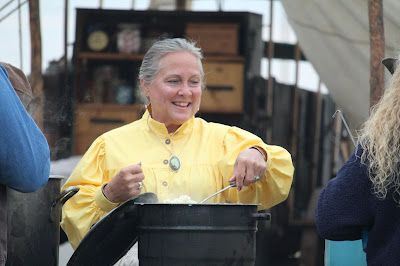
Laura Jones at the Fort Wallace Museum, Photo by J. Denise Coalson Each year at the Fort Wallace Museum, Doc and Laura Jones set up their ch...